
News & Blog
Monthly Updates: October 2015
In September, ways to make the virtual world more accessible were addressed.
Panoramic Exhibit
Wish you were there? Well now you can be! Visit the 3D Panorama:
Sea Winds and Immigrant Songs
Bat Out of Hell Kozachok: During the Mnohaya'lita exhibit and anniversary celebrations in 2012, a concert was held entitled Sea Winds and Immigrant Songs. Please click on the photo to listen to bandurist Julian Kytasty and fiddler Colin Grant play a musical piece called "Bat Out of Hell Kozachok". To view other clips of the concert, please visit the Sea WInds and Immigrant Songs page located in the "Mnohaya'lita!" exhibit section of the curated exhibits under the Interactive Resources tab at the top of the screen.
St. Cecilia's Choir
St. Cecilia's Choir from St. Mary's Polish Church performed a tribute concert with the Men of the Deeps for their centenary on July 6th and 2013. Here are three video clips from that concert and this heavenly choir:
Pinch Me: Rose Best's Beet Horseradish
Pinch Me is a cooking series about how immigrants have adapted their traditional cooking methods over the years to incorporate local foods. Rose Best from the Ukrainian community shows us how to cook Beet Horseradish Cape Breton style! Please follow the link: /items/diversity_888.html
Ukrainian Dance
For our first daily blog, we are pleased to present content about Ukrainian dance traditions in Cape Breton from the "Monhaya lita!" Exhibit. This exhibit, which celebrated one hundred years of Ukrainian faith in Cape Breton, took place at the Lyceum in Sydney, Nova Scotia, in November of 2012. All of this content can be found within the archive.
Diversity Cape Breton Launch Date
The lauch date for diversitycapebreton.ca will be taking place on August 1st, 2015. As we prepare for the official launch, please check back here for daily updates and new content.
Diversity Cape Breton Pre-Launch
The pre-launch of the diversitycapebreton.ca web portal will be taking place this week at Cape Breton University, as part of the Canadian Society for Traditional Music's Curating Ethnomusicology pre-conference workshops. This will be an opportunity for conference participants to give preliminary feedback on the portal and to ask any questions they may have of the diversitycapebreton project team. We invite you to join us for the public launch of the web portal and related workshops in August. Check back soon for details! Here's to a successful pre-launch!
Curating Sites of Ethnographic Inquiry
"Jewish Life on Cape Breton Island” has been the title of multiple projects dedicated to research of the same topic. It has been a radio program, a series of sound pieces, and a curated environment at York University. Through local collections created by members of the community, archival research relied not only on the expertise of the archivists at the Beaton Institute, but the expert knowledge of the individuals that collected the materials in the first place. While collecting these materials for the Diversity Cape Breton web portal there was a unique opportunity to, as Srinivasan et al write, “reconsider the nature of the catalog, and how new technologies allow different sorts of engagement with local descriptions and vernacular accounts from diverse expert communities.” (2006, pp266) Both the Chernin collection and the Dubinsky family recordings held at the Beaton became instrumental in curating a space at the Gales Gallery, York University, for former residents now living in Toronto.
Memories of Gusle and Ganga in Cape Breton's Croatian Community
Many of the second and third generation Cape Breton Croatians remembered their parents’ and grandparents’ LP records. Some of the recording that were frequently being mentioned, included two traditional music idioms, gusle and ganga, both characteristic for Herzegovina and the Dinaric part of South-eastern Europe. Gusle is a one or two-string bowed instrument held in the lap and played by a single player/singer. Gusle music refers not just to the playing of the instrument, but also to the singing, since gusle is commonly used for accompaniment of a singer-storyteller and the melody played on the instrument is only a slightly ornamented version of the melody performed by the voice. Ganga, on the other hand, refers to a vocal music genre that uses a specific voice-shaking technique and is performed by a group of singers. Please see the following videos for some samples of these two musical styles:
Jewish Life and Belonging on Cape Breton Island
As a child of Jewish parents, with roots in the community, I knew that the Jewish population on Cape Breton Island was dwindling. However, I had not realised the full extent of the exodus of families to larger cities in Canada, mostly here in Toronto. What was once an island with four synagogues - in Sydney, Whitney Pier, Glace Bay and New Waterford - now has only one in use.
Unveiling of St. Mary's Polish Church Design Plans
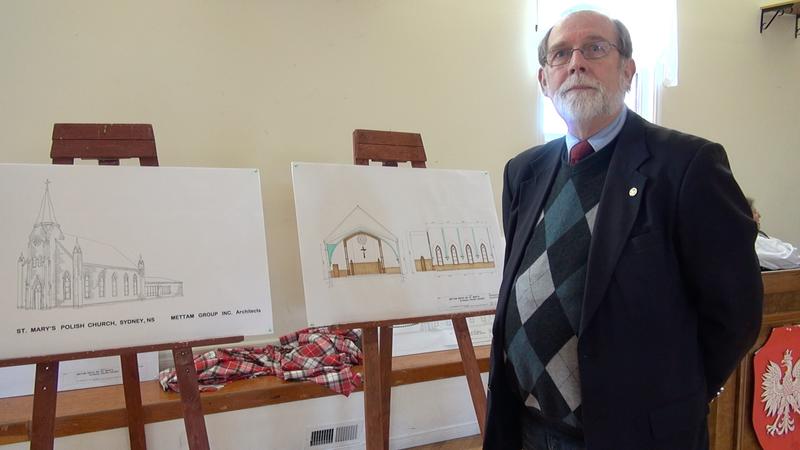 November 29, 2014 was an overwhelmingly tragic day for members of the Cape Breton Polish community. Their beloved church, standing for over 100 years, was devastated by fire. St Mary’s Polish Parish, built in 1913, was central to the Polish community of Cape Breton, holding weekly mass for over ninety parishioners and organizing many cultural and religious celebrations. The loss of the historic and beautiful church, located on 21 Wesley St. in Whitney Pier, was felt not only by the Polish community, but by the Cape Breton community as a whole. The church was a designated provincial and municipal heritage site, and it represented the proud multiculturalism of Cape Breton - it tethered residents to the beautiful history of the island.
A Short History of the Tamburica, a Croatian Traditional Instrument
Tamburica or tambura is a traditional plucked string instrument that came to South-eastern Europe from Asia around 15th century through the Turkish conquests. Although by no means an endemic Croatian instrument, tambura became a symbol of Croatian ethnic identity in the early 19th century, when the process of formation of national identities was taking part all over Europe. Croatian nationalist movement in the mid-19th century had a decisive impact on the popularity and perception of tambura, resulting in its gradual inauguration as national instrument. At that time, tambura also experienced changes in construction and function. In the earlier stage of its history, tambura was a soloist instrument mostly found in villages. In 19th century, larger ensembles and orchestras of tambura were starting to form in towns, modelled on bourgeois singing choirs. The first such ensembles were even called “tambura choirs” since they had developed into different variants and sizes of the instrument covering ranges from soprano to bass. There are commonly five variants of tambura still used in ensembles and orchestras today with their own distinctive names. From the highest in pitch to the lowest, they are called: bisernica or prim, brač, čelo, čelović and berda or bas.
Welcome to Diversity Cape Breton!
We have been busy with community consultations to help us develop this site and our materials. Recently we introduced our curriculum resources development team – Eric Favaro and Daria Storoshchuk – in Sydney’s Ukrainian community at an event at the Ukrainian Hall.
2015
- Monthly Updates: October 2015
- Panoramic Exhibit
- Sea Winds and Immigrant Songs
- St. Cecilia's Choir
- Pinch Me: Rose Best's Beet Horseradish
- Ukrainian Dance
- Diversity Cape Breton Launch Date
- Diversity Cape Breton Pre-Launch
- Curating Sites of Ethnographic Inquiry
- Memories of Gusle and Ganga in Cape Breton's Croatian Community
- Jewish Life and Belonging on Cape Breton Island
- Unveiling of St. Mary's Polish Church Design Plans
- A Short History of the Tamburica, a Croatian Traditional Instrument
- Welcome to Diversity Cape Breton!